Key Facts
- Nearly half of Americans believe in ghosts. We examine the scientific evidence — and the psychological explanations — behind one of humanity's oldest beliefs.
- Editorial verdict: Fake
- Estimated reading time: 2 minutes (406 words)
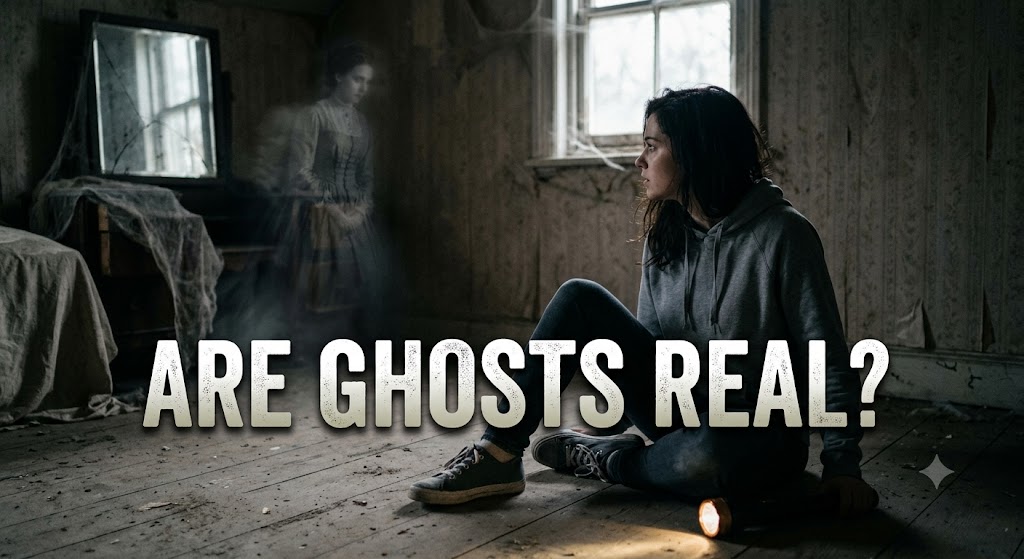
Belief in ghosts is strikingly common. A 2021 Ipsos poll found that 46% of Americans believe in ghosts, and similar numbers are found worldwide. Ghost stories appear in virtually every culture throughout human history. But after centuries of claims, is there any scientific evidence that ghosts exist?
The Claims
People who report ghost experiences typically describe:
- Seeing apparitions or shadow figures
- Hearing unexplained sounds — footsteps, whispers, knocking
- Feeling sudden temperature drops or a "presence" in the room
- Objects moving or electronics malfunctioning
- Feeling touched or pushed by an unseen force
The Scientific Investigations
Despite widespread belief, no scientific study has ever produced repeatable, verifiable evidence for ghosts:
- James Randi Educational Foundation: The JREF offered a $1 million prize for decades to anyone who could demonstrate supernatural phenomena under controlled conditions. The prize was never claimed
- CERN physicist's argument: Physicist Brian Cox has argued that the Large Hadron Collider's particle detection capabilities effectively rule out the existence of ghosts — any energy pattern capable of interacting with the physical world (moving objects, being visible) would have been detected
- Ghost-hunting equipment: Devices like EMF meters and infrared cameras used by paranormal investigators were not designed to detect ghosts and have no validated scientific connection to the supernatural
Think you know something that's real or fake?
The community is waiting. Submit your question and let thousands of people vote on it.
Submit Your QuestionWhat Science Actually Explains
Researchers have identified numerous natural causes for "ghostly" experiences:
- Infrasound: Low-frequency sound waves (below 20 Hz) can cause feelings of unease, dread, and even visual disturbances. Researcher Vic Tandy discovered that a "haunted" laboratory had an extractor fan producing 18.9 Hz sound waves — the exact frequency that can cause the human eye to vibrate, producing peripheral visual anomalies
- Carbon monoxide poisoning: Low-level CO exposure causes hallucinations, feelings of dread, and confusion — and has been linked to many classic haunting reports
- Sleep paralysis: This condition, which affects about 8% of the population, involves waking up unable to move while experiencing vivid hallucinations — often of shadowy figures
- Pareidolia: The brain's tendency to find meaningful patterns in random stimuli (seeing faces in shadows, hearing words in white noise)
- Grief and expectation: Bereaved individuals commonly report sensing the presence of deceased loved ones, a well-documented psychological phenomenon
Our Verdict
There is no scientific evidence that ghosts are real. Every controlled study has failed to produce verifiable proof, and well-understood psychological and environmental factors can explain virtually all reported ghost experiences. Belief in ghosts is deeply human and culturally significant — but it is not supported by evidence.
Related Videos
Scroll to browse videos
What do you think?
Cast your vote and see what the community thinks
0 total votes
No account needed — vote anonymously
Got something to investigate?
Submit your own "Is X real or fake?" question and let the community vote.
Discussion
No comments yet
Be the first to share your thoughts.