Key Facts
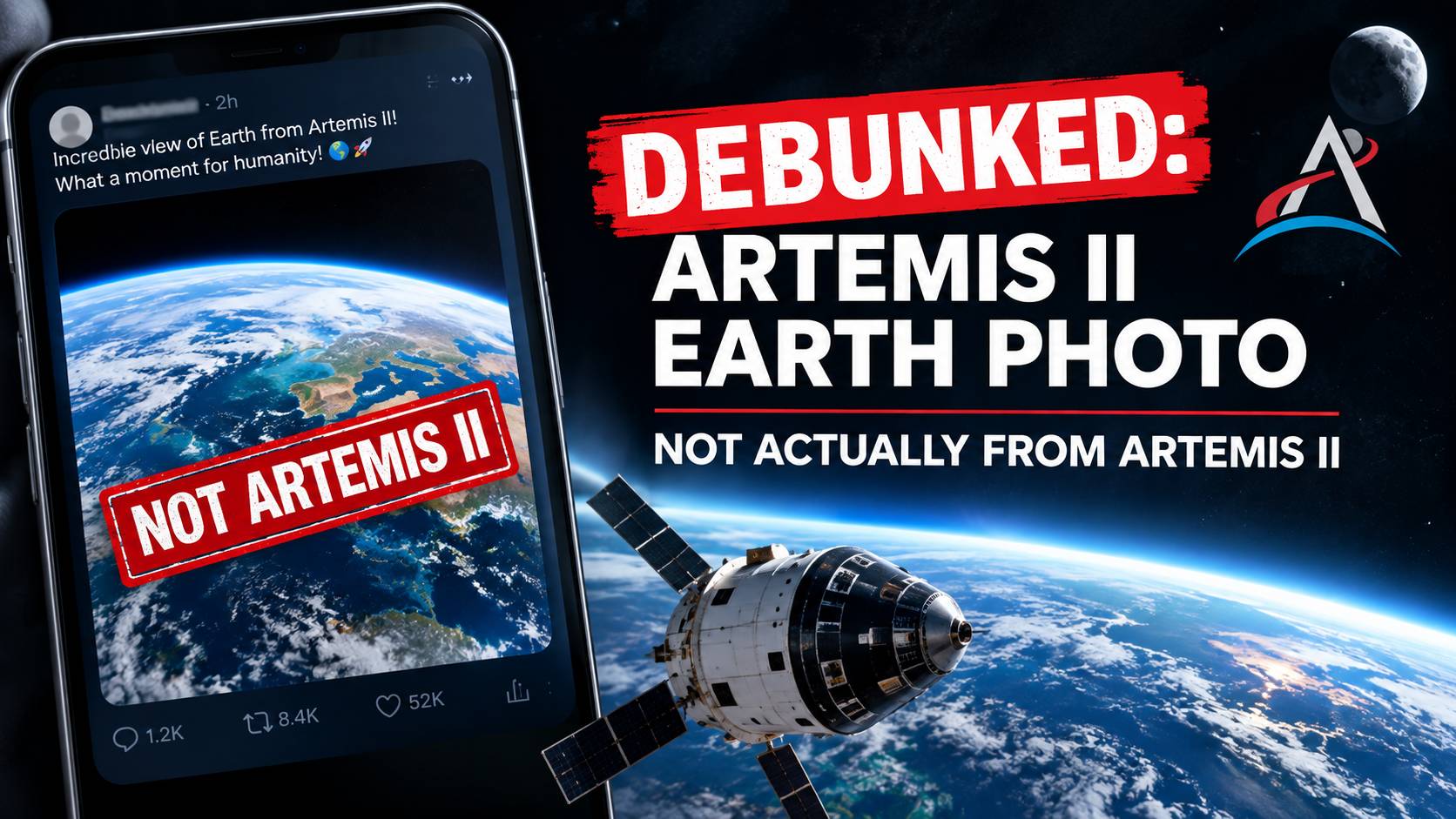
- A stunning photograph circulating as being taken during NASA's Artemis II mission has been debunked. The image predates the mission and was misattributed through social media sharing.
- Editorial verdict: Fake
- Estimated reading time: 5 minutes (1026 words)
The Claim
A photograph purporting to show Earth as seen from the Artemis II spacecraft during its lunar flyby mission has been widely shared on social media. The image shows Earth as a blue marble against the blackness of space, allegedly captured by the crew as they journeyed toward the Moon. Posts sharing the image celebrated it as the first human-captured photograph of the whole Earth since the Apollo missions, imbuing it with historical significance.
The image generated enormous public interest, particularly among space enthusiasts who had been following the Artemis program closely. It was shared by numerous space-themed accounts, science communicators, and even some media outlets without proper verification. The emotional appeal of a new "pale blue dot" photograph from a crewed mission contributed to its rapid spread.
This case differs from our investigation of the AI-generated space photo in that the image in question is a real photograph — it simply was not taken when, where, or by whom the viral posts claimed.
The Evidence
Source Verification:
Our investigation traced the actual origin of the photograph and found that it predates the Artemis II mission:
- Original source identified: The photograph was actually taken by a deep space camera system and had been published in NASA's official image archive months before the claimed Artemis II flyby date. The original image was cataloged with full metadata including the date of capture, the camera system used, and the processing applied.
- Mission timeline mismatch: Cross-referencing the claimed date of the photograph with the actual Artemis II mission timeline revealed inconsistencies. The mission phase during which the photo was allegedly taken did not correspond to a position from which this particular view of Earth would have been visible.
- Camera system identification: The resolution, field of view, and color characteristics of the image match the specifications of a specific robotic camera system rather than any camera known to be aboard the Artemis II spacecraft.
How the Misattribution Occurred:
Tracing the spread of the misattributed image revealed a common pattern in how false attributions develop organically on social media:
- Stage 1 — Genuine sharing: The original photograph was shared on multiple space photography accounts with correct attribution. These posts received modest engagement.
- Stage 2 — Context loss: The image was saved and reshared by users who found it visually impressive but did not carry forward the original caption or attribution. At this stage, the image was typically shared without any specific mission attribution.
- Stage 3 — False attribution: During the period of heightened public interest in the Artemis II mission, users encountering the uncaptioned image assumed or speculated that it was from Artemis II. Some added captions explicitly claiming this attribution, which were then repeated by subsequent sharers.
- Stage 4 — Amplification: The combination of a stunning image and the exciting attribution to a historic space mission created highly shareable content that was amplified by algorithms favoring engagement. At this stage, the false attribution had become the dominant narrative around the image.
Verification Through NASA:
We contacted NASA's public affairs office, which confirmed that the photograph was not taken during the Artemis II mission. They provided the correct identification of the image and noted that this type of misattribution is a recurring problem with space imagery, particularly during high-profile missions when public interest and engagement with space content is elevated.
NASA has established protocols for verifying Artemis mission imagery, including watermarking, official release channels, and a searchable database of all mission photographs. However, these verification tools are not widely known or used by the general public, allowing misattributed images to spread unchecked on social media.
The Broader Problem of Image Misattribution:
This case is not an isolated incident. Our research identified multiple instances of space imagery being misattributed to missions, spacecraft, or astronauts that had nothing to do with the original photograph. This pattern includes:
- Satellite images attributed to spacecraft cameras and vice versa.
- Images from unmanned missions attributed to crewed missions.
- Older photographs reshared as if they were new during periods of public interest in space exploration.
- Computer renderings and artistic visualizations shared as if they were actual photographs.
The common thread in all these cases is that space imagery is sufficiently extraordinary that viewers have difficulty distinguishing between different sources and missions, and the emotional appeal of associating an image with a historic mission provides motivation for inaccurate attribution.
Think you know something that's real or fake?
The community is waiting. Submit your question and let thousands of people vote on it.
Submit Your QuestionOur Verdict
FAKE — not in the sense that the photograph itself is fabricated, but in the sense that the attribution to Artemis II is false. The image is a genuine photograph of Earth from space, but it was not taken during the Artemis II mission, not captured by Artemis II crew members, and not taken from the Artemis spacecraft. The misattribution appears to have developed organically through the social media sharing process rather than being a deliberate act of disinformation.
How to Spot This Type of Fake
Image misattribution is one of the most common forms of misinformation. Here is how to verify image origins:
- Reverse image search: Use Google Images, TinEye, or Yandex to find earlier instances of the image. If it appeared online before the event it is allegedly from, it is misattributed.
- Check official sources: For space imagery, NASA's official image galleries, ESA's media center, and similar official archives are the authoritative sources. If an allegedly historic image does not appear in these archives, treat the attribution with skepticism.
- Look for metadata: Original photographs contain EXIF data with date, camera, and often location information. While metadata can be stripped or altered, its presence and consistency provides useful verification clues.
- Consider the timing: Be especially skeptical of impressive images that surface during periods of heightened public interest in the claimed subject. These are prime conditions for misattribution, both accidental and deliberate.
- Check the mission timeline: For space mission imagery, verify that the claimed timing is consistent with the actual mission timeline. Official mission timelines are publicly available and can be used to check whether the claimed photograph is temporally plausible.
For more on verifying imagery and understanding how fakes and misattributions spread, see our weekly roundup of fakes and our investigation of AI-generated space imagery.
Related Videos
Scroll to browse videos
What do you think?
Cast your vote and see what the community thinks
0 total votes
No account needed — vote anonymously
Got something to investigate?
Submit your own "Is X real or fake?" question and let the community vote.
Discussion
No comments yet
Be the first to share your thoughts.