Key Facts
- A stunning photograph widely shared as an authentic space image has been revealed as AI-generated. We examine how it fooled millions and how to verify genuine space imagery.
- Editorial verdict: Fake
- Estimated reading time: 5 minutes (925 words)
The Claim
A breathtaking photograph showing Earth from an unusual orbital perspective, with the aurora borealis visible in stunning detail and the Milky Way stretching across the background, has been widely shared on social media with captions attributing it to various space missions. Some posts claimed it was taken by astronauts aboard the International Space Station, while others attributed it to the James Webb Space Telescope or various satellite imaging systems.
The image was strikingly beautiful, showing a level of detail and color that made it stand out from typical space photography. It was shared by science enthusiasts, space agency fan accounts, and even some educational institutions as an example of the beauty of our planet from space. Several accounts used it as a background for inspirational quotes about Earth and humanity's place in the cosmos.
Our investigation was prompted by questions from observant followers who noticed that the image did not quite match the visual characteristics of any known space photography system. What we found illustrates the growing challenge of distinguishing AI-generated imagery from genuine space photography — a task complicated by the fact that real space photos often look so extraordinary that they seem artificial to begin with.
The Evidence
Astronomical Verification:
Our first step was to verify the astronomical accuracy of the image. We consulted with two astronomers and used astronomical software to analyze the star field, Earth's position, and the aurora display:
- Star field errors: The constellation patterns visible in the image do not match any real star field configuration. While the stars look individually realistic, their arrangement does not correspond to actual stellar positions visible from any orbit around Earth. This is a strong indicator of AI generation, as current models create plausible-looking but astronomically incorrect star fields.
- Aurora impossibility: The aurora display shown in the image extends to latitudes and altitudes that are physically impossible. Real auroral displays occur in bands around the magnetic poles, typically between 60 and 75 degrees magnetic latitude. The aurora in this image appears to cover most of the visible hemisphere, which would require a geomagnetic storm of unprecedented magnitude.
- Earth geography: The continental outlines visible in the image contain subtle but definitive errors. Coastlines are approximately correct but differ in detail from actual geography, particularly around island chains and peninsulas. This is consistent with AI models that have learned approximate continental shapes but do not reproduce them with cartographic accuracy.
- Atmospheric rendering: The atmosphere's appearance, including its thickness relative to Earth's diameter and the way it transitions from troposphere to stratosphere, does not match the physical reality. Real space photographs show a much thinner atmospheric layer relative to Earth's curvature.
Camera and Source Verification:
We attempted to identify the camera system that allegedly captured this image:
- The image resolution and field of view do not match any camera system currently deployed on the ISS or any known satellite.
- NASA's image archive, ESA's media library, JAXA's photo databases, and Roscosmos's public image collections were all searched. The image does not appear in any official space agency archive.
- The perspective and field of view suggest an orbital altitude of approximately 400-500 km, consistent with ISS altitude, but no ISS crew photograph matches this image.
- No photographer or space agency has claimed authorship of the image, despite its widespread circulation.
AI Detection Analysis:
The image was submitted to multiple detection tools:
- Hive Moderation classified it as AI-generated with 91% confidence.
- Spectral analysis revealed the characteristic frequency domain patterns associated with diffusion-based image generation.
- The noise pattern in the image was uniform and consistent with AI generation rather than the sensor-specific noise patterns produced by space-qualified cameras.
Think you know something that's real or fake?
The community is waiting. Submit your question and let thousands of people vote on it.
Submit Your QuestionOur Verdict
FAKE. This image is AI-generated. The star field is astronomically incorrect, the aurora display is physically impossible at the shown extent, the continental geography contains subtle errors, and the image does not appear in any space agency archive. Despite its stunning beauty and superficial realism, it was not captured by any camera in space.
This case is particularly interesting because space photography represents a domain where real images often look extraordinary enough to seem artificial. This makes it easier for AI-generated space images to pass as genuine — viewers are already accustomed to being amazed by real space photos, so they are less likely to question an AI-generated one that looks similarly spectacular.
How to Spot This Type of Fake
Verifying space imagery requires some specialized knowledge, but several techniques are accessible to anyone:
- Check official archives: Real space photographs are cataloged in official archives. NASA's Image Gallery, ESA's Multimedia Centre, and other space agency databases are searchable. If an impressive space photo does not appear in any official archive, be skeptical.
- Verify star fields: Use free astronomy software like Stellarium to check whether visible constellations match what would actually be visible from the claimed perspective and time. AI-generated images almost always get star fields wrong.
- Check the geography: Zoom in on visible coastlines and compare them to actual maps. AI-generated images of Earth often show approximately correct but subtly wrong geography.
- Look for attribution: Genuine space photographs come with detailed metadata including the photographer's name, the mission, the date, and the camera settings. Images without this attribution should be treated with suspicion.
- Consider the composition: Real space photographs are constrained by the physical limitations of cameras and orbital mechanics. Images that seem too perfectly composed or that show an impossible combination of features may be AI-generated.
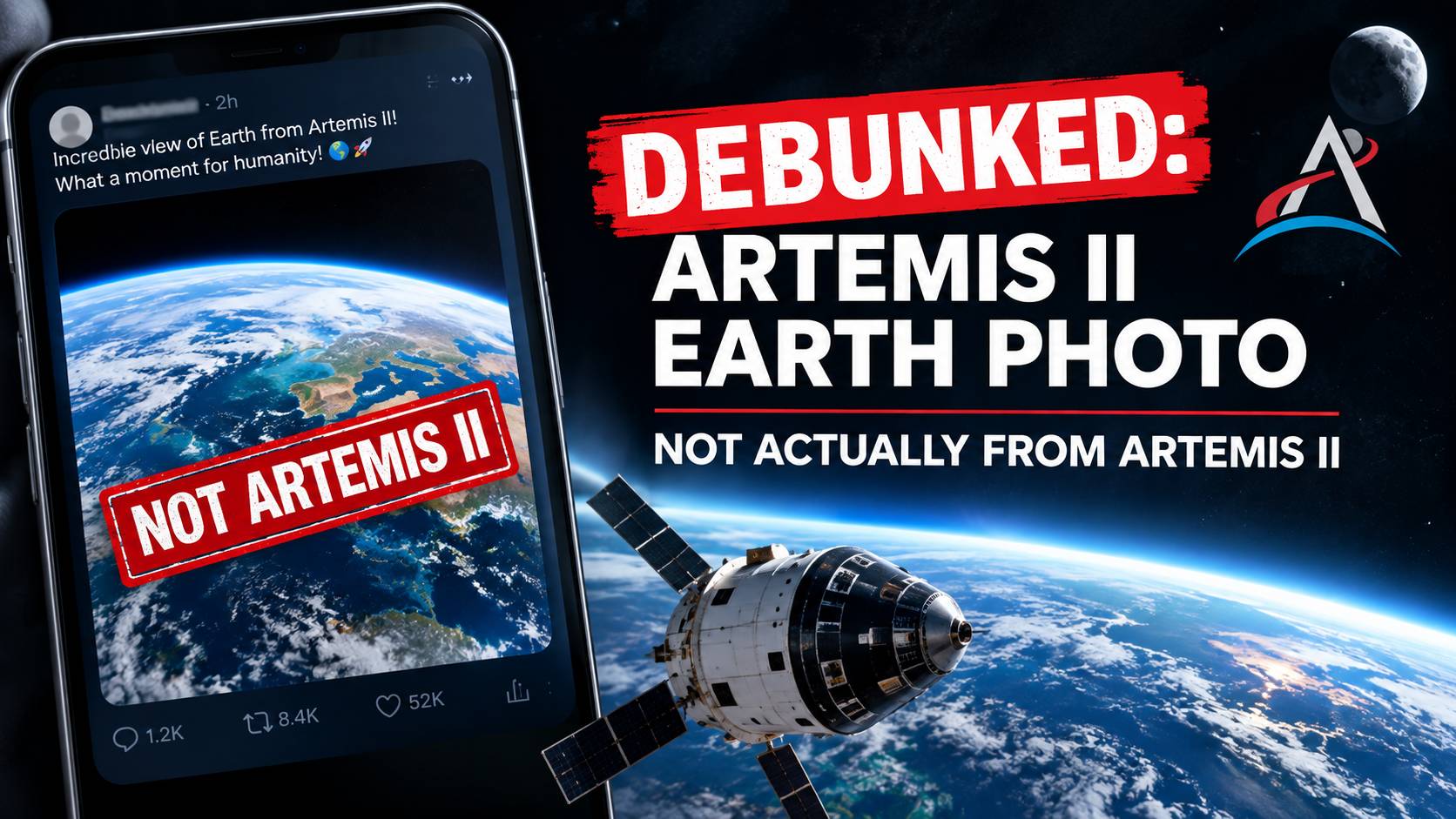
For a related investigation, see our analysis of the misattributed Artemis II photo and our weekly viral photo roundup.
Related Videos
Scroll to browse videos
What do you think?
Cast your vote and see what the community thinks
0 total votes
No account needed — vote anonymously
Got something to investigate?
Submit your own "Is X real or fake?" question and let the community vote.
Discussion
No comments yet
Be the first to share your thoughts.