Key Facts
- The lost city of Atlantis has fascinated humanity for over 2,000 years. We trace the legend back to its source and examine whether any evidence supports its existence.
- Editorial verdict: Fake
- Estimated reading time: 2 minutes (390 words)
Atlantis is one of the most enduring legends in human history — a powerful, advanced civilization said to have sunk beneath the ocean in a single day. Thousands of books, documentaries, and theories have been dedicated to finding it. But is there any chance Atlantis was real?
The Origin: Plato's Dialogues
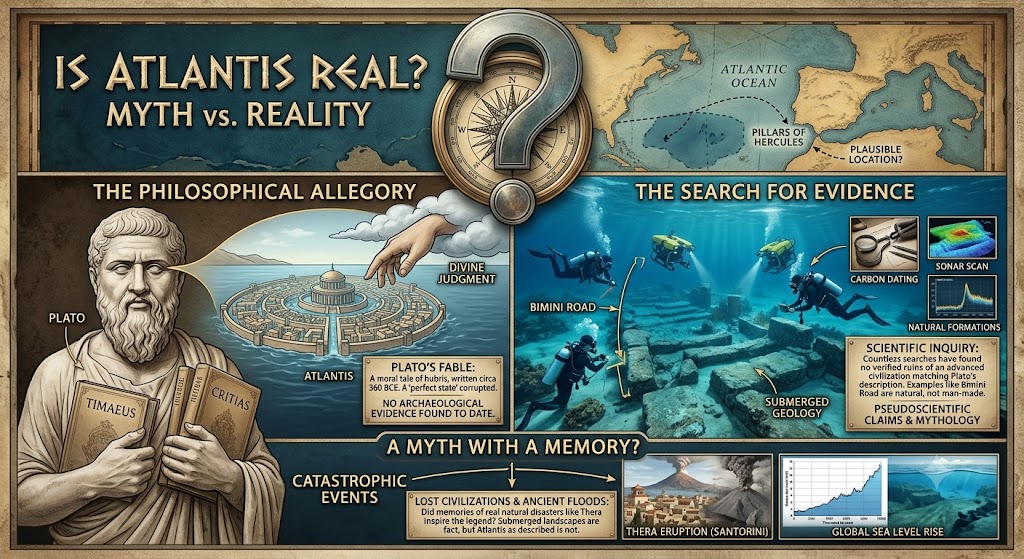
The story of Atlantis comes from exactly one source: the ancient Greek philosopher Plato, who described it in two dialogues — Timaeus and Critias — written around 360 BC. According to Plato, Atlantis was a vast island empire located "beyond the Pillars of Hercules" (the Strait of Gibraltar) that existed 9,000 years before his time.
Plato described Atlantis as a wealthy, technologically advanced civilization with concentric rings of water and land, magnificent architecture, and a powerful navy. He wrote that the Atlanteans became greedy and morally corrupt, and the gods punished them by sinking their island into the sea in a single day and night.
Was Plato Writing Fiction?
Most classical scholars believe Atlantis was a philosophical allegory, not a historical account. Key reasons:
- Plato was known for using fictional stories to illustrate philosophical points — his dialogues are full of parables and thought experiments
- The story served his argument about the corruption of powerful societies, a recurring theme in his work
- No other ancient Greek historian — including Herodotus, Thucydides, or Aristotle (Plato's own student) — ever mentioned Atlantis as a real place
- Aristotle reportedly stated that Plato invented Atlantis to make a philosophical point
Think you know something that's real or fake?
The community is waiting. Submit your question and let thousands of people vote on it.
Submit Your QuestionPopular Theories
Despite scholarly consensus, numerous theories have attempted to locate Atlantis:
- Santorini/Minoan civilization: The volcanic eruption that destroyed the Minoan settlement on Thera around 1600 BC is often cited as a possible inspiration. However, the timeline and geography don't match Plato's description
- Richat Structure (Mauritania): A circular geological formation in the Sahara went viral on social media as a possible Atlantis site, but geologists confirm it's a natural erosion feature — not man-made
- Antarctica, Caribbean, Indonesia: Various fringe theories place Atlantis in exotic locations, but none have produced archaeological evidence
Our Verdict
Atlantis is not real. It was a fictional creation by Plato, used as a moral parable about the dangers of hubris and corruption. No archaeological evidence for a sunken advanced civilization has ever been found, and the scholarly consensus is clear: Atlantis was a philosophical story, not a historical record.
Related Videos
Scroll to browse videos
What do you think?
Cast your vote and see what the community thinks
0 total votes
No account needed — vote anonymously
Got something to investigate?
Submit your own "Is X real or fake?" question and let the community vote.
Discussion
No comments yet
Be the first to share your thoughts.