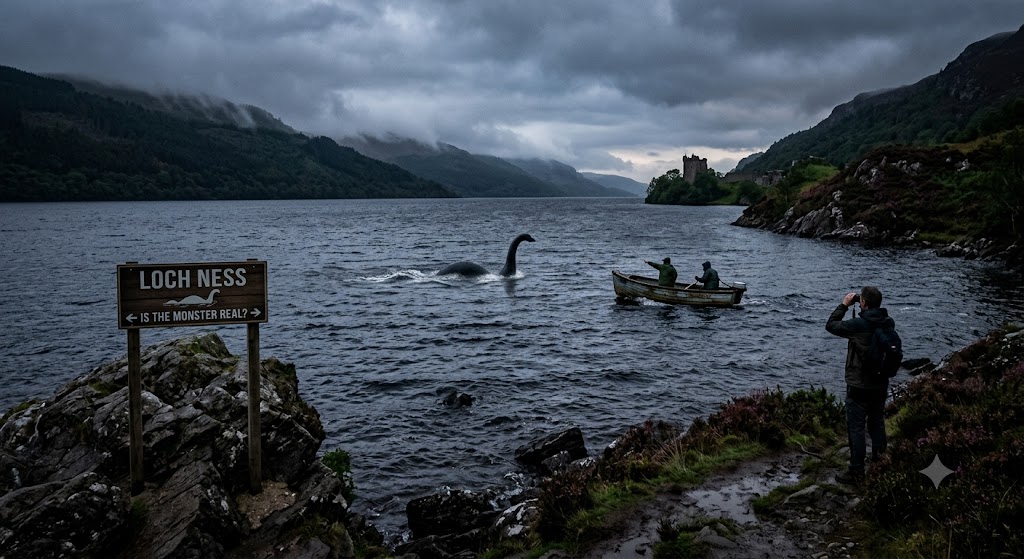
Key Facts
- For nearly a century, people have claimed to spot a mysterious creature in Scotland's Loch Ness. We examine the evidence behind the world's most famous cryptid.
- Editorial verdict: Fake
- Estimated reading time: 2 minutes (404 words)
The Loch Ness Monster — affectionately known as "Nessie" — is arguably the world's most famous cryptid. Since the 1930s, thousands of alleged sightings have been reported in Loch Ness, a deep freshwater lake in the Scottish Highlands. But does a giant creature really lurk beneath its dark waters?
The Origins of the Legend
The modern Nessie phenomenon began in 1933, when a couple driving along the newly built road beside Loch Ness reported seeing "an enormous animal rolling and plunging" in the water. The story was published in the Inverness Courier, and within months the world was gripped by Nessie fever.
The most iconic piece of evidence came in 1934 — the famous "Surgeon's Photograph," showing what appeared to be a long-necked creature rising from the water. For decades, it was considered the strongest proof of Nessie's existence. In 1994, however, it was revealed to be a hoax — a toy submarine fitted with a sculpted head, staged by Marmaduke Wetherell as revenge against the Daily Mail after they discredited his earlier faked footprints.
Scientific Investigations
Multiple scientific expeditions have searched the loch:
- Operation Deepscan (1987): A fleet of 24 boats equipped with sonar swept the entire loch. Results were inconclusive — three sonar contacts were recorded at depth, but scientists could not confirm they were biological
- BBC Sonar Survey (2003): A comprehensive sonar sweep found no trace of any large animal in the loch
- eDNA Study (2019): Researchers from the University of Otago collected water samples from across the loch and analyzed environmental DNA. They found no evidence of any large unknown species — but did find significant amounts of European eel DNA, suggesting that sightings may involve unusually large eels
Think you know something that's real or fake?
The community is waiting. Submit your question and let thousands of people vote on it.
Submit Your QuestionWhat People Are Probably Seeing
Experts suggest that Nessie sightings can be attributed to several factors: large eels, floating logs, boat wakes viewed from a distance, optical illusions caused by the loch's dark peat-stained water, and simple wishful thinking. Loch Ness is deep (up to 230 meters), cold, and murky — conditions that make misidentification easy.
Our Verdict
The Loch Ness Monster is not real. Despite nearly a century of searching, no credible scientific evidence supports the existence of a large unknown creature in the loch. The most famous evidence — the Surgeon's Photograph — was a confirmed hoax, and modern eDNA analysis found nothing unusual. Nessie is a fascinating cultural legend, but she remains firmly in the realm of myth.
Related Videos
What do you think?
Cast your vote and see what the community thinks
0 total votes
No account needed — vote anonymously
Got something to investigate?
Submit your own "Is X real or fake?" question and let the community vote.
Discussion
No comments yet
Be the first to share your thoughts.