Key Facts
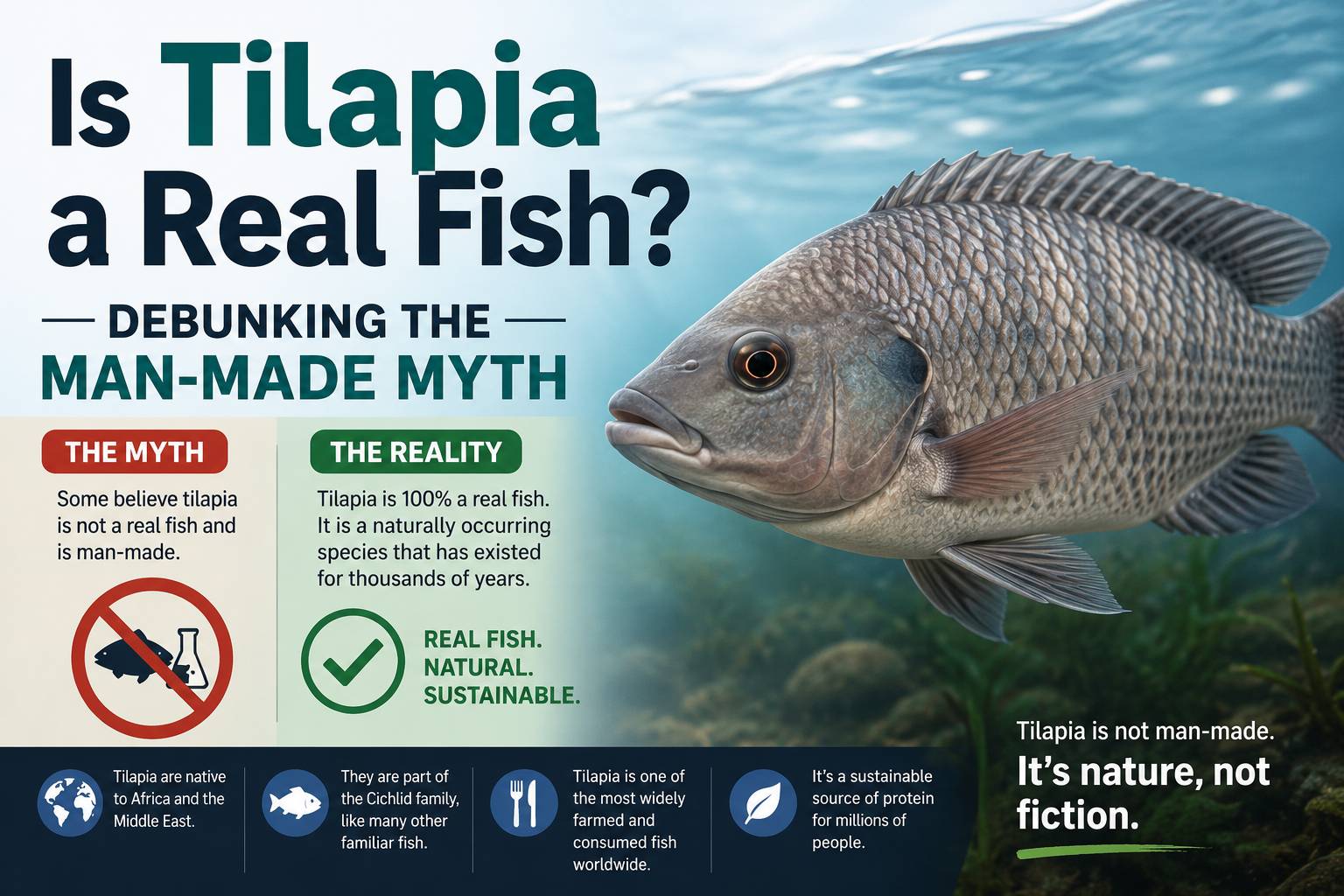
- A viral claim suggests tilapia isn't a real fish but a man-made creation with no skin or bones. We investigate this widespread myth and uncover the surprising 4,000-year history of this ancient fish.
- Editorial verdict: Real
- Estimated reading time: 3 minutes (504 words)
Scroll through social media long enough and you'll encounter a viral claim that refuses to die: "Tilapia is not a real fish — it's man-made." Some versions go further, claiming tilapia has no skin, no bones, and was genetically engineered in a lab. With tilapia being the fourth most consumed seafood in the United States, these claims have understandably alarmed millions of consumers.
So what's the truth?
Tilapia Is 100% a Real Fish
Tilapia is absolutely a real fish. The name "tilapia" is actually a common name for nearly 100 species of cichlid fish from the tilapiine cichlid tribe. These are freshwater fish native to Africa and the Middle East, where they have existed in the wild for millions of years.
Like all real fish, tilapia have scales, bones, fins, gills, and skin. They breathe underwater, reproduce naturally, and exist in wild populations across multiple continents.
A 4,000-Year History
Far from being a modern creation, tilapia is believed to be the oldest farm-raised fish in human history. Depictions of tilapia being raised in ponds have been found in ancient Egyptian tombs dating back approximately 4,000 years.
References to tilapia appear throughout ancient history:
- Ancient Egypt — Tilapia was associated with rebirth and was a staple food source
- Biblical times — Scholars believe tilapia (specifically Sarotherodon galilaeus) may be the fish Jesus used to feed the masses at the Sea of Galilee
- Roman Empire (1500 BC) — Historical records mention tilapia farming
Think you know something that's real or fake?
The community is waiting. Submit your question and let thousands of people vote on it.
Submit Your QuestionWhere Did the Myth Come From?
The confusion likely stems from several factors:
- Farm raising — Because most tilapia sold in stores comes from fish farms (aquaculture), some people mistakenly assumed this means the fish itself was "created" or "engineered"
- Mild flavor — Tilapia's very mild, almost neutral taste led some to believe it couldn't be a "real" fish
- Unfamiliar name — Unlike salmon or tuna, "tilapia" sounds unusual to English speakers, fueling suspicion
- Viral misinformation — Social media posts mixing legitimate concerns about farmed fish practices with completely false claims about tilapia being man-made
Legitimate Concerns vs. Myths
While tilapia being "fake" is a myth, there are real discussions worth having about farmed tilapia:
- Omega-3 content — Tilapia has less omega-3 fatty acids than salmon or mackerel, but it's still a lean, healthy protein source
- Farming practices — Quality varies by farm; look for certifications like ASC (Aquaculture Stewardship Council)
- Environmental impact — Responsibly farmed tilapia has a relatively low environmental footprint compared to many other animal proteins
Tilapia is low in mercury, high in protein, and contains essential nutrients including vitamin B12, niacin, and selenium.
Our Verdict
Tilapia is a real fish — and one of the oldest domesticated fish species on Earth. The claim that it's "man-made" or artificial is completely false. Tilapia is a natural freshwater fish with a documented history spanning at least 4,000 years. While it's widely farmed today (just like chickens, cattle, and salmon), farming a species doesn't make it man-made. The viral myth likely arose from confusion about aquaculture practices combined with social media misinformation.
Related Videos
Scroll to browse videos
What do you think?
Cast your vote and see what the community thinks
0 total votes
No account needed — vote anonymously
Got something to investigate?
Submit your own "Is X real or fake?" question and let the community vote.
Discussion
No comments yet
Be the first to share your thoughts.