Key Facts
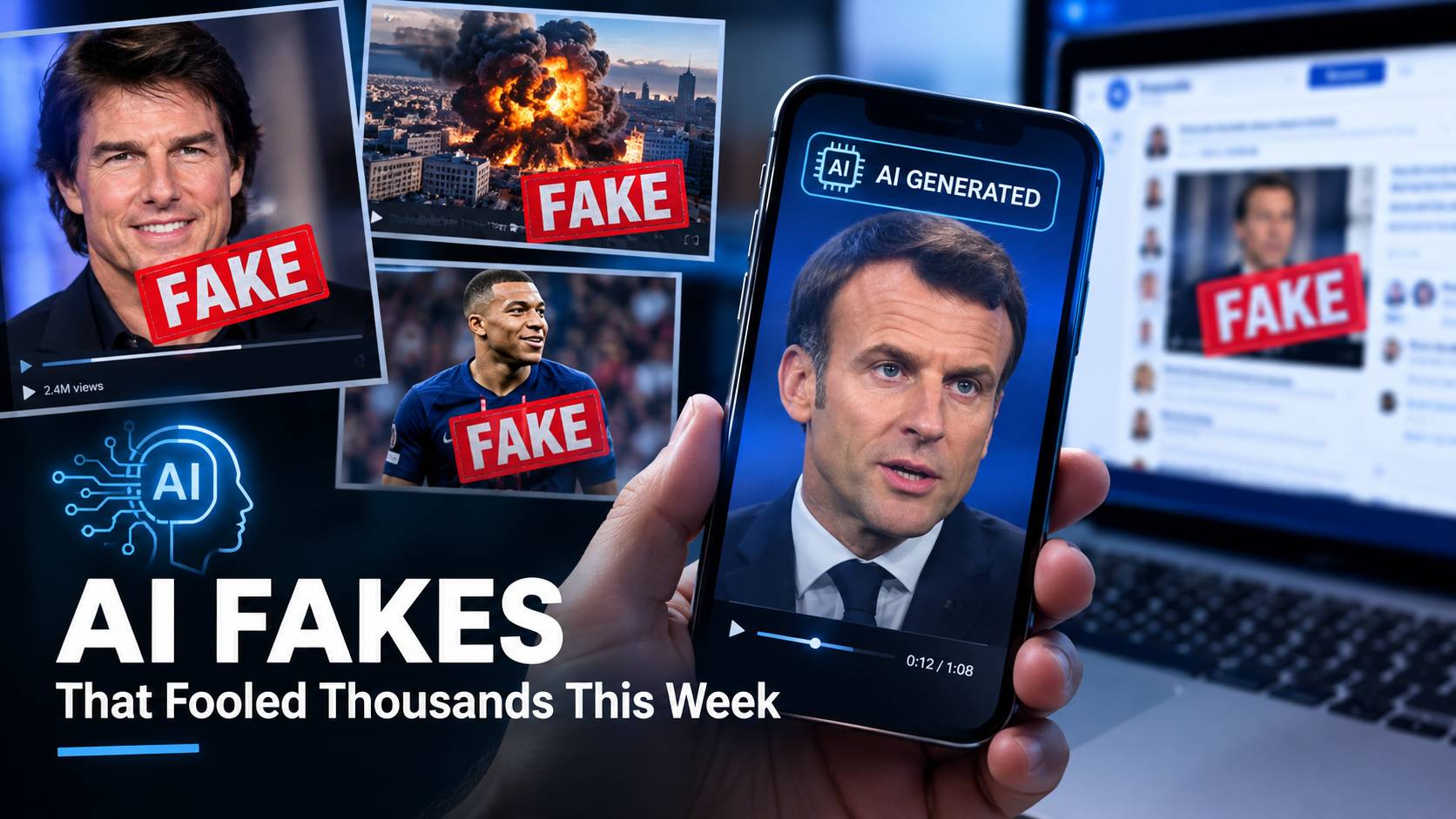
- A viral video appearing to show Indian Trade Minister Piyush Goyal making controversial statements about trade policy has been identified as a sophisticated deepfake. Here is how it was made and detected.
- Editorial verdict: Fake
- Estimated reading time: 4 minutes (887 words)
The Claim
A video circulating on Indian social media appeared to show Union Commerce and Industry Minister Piyush Goyal making explosive statements about India's trade policy during what looked like a private meeting. In the video, the figure resembling Goyal appeared to admit that certain trade agreements were designed to benefit specific corporate interests rather than the broader Indian economy, and suggested that foreign pressure had influenced key policy decisions.
The video, approximately 90 seconds long, showed a figure with Goyal's likeness speaking in Hindi with English phrases interspersed, consistent with the Minister's known speaking style. The setting appeared to be a conference room, and the video quality was deliberately degraded, ostensibly to suggest it was recorded surreptitiously on a mobile phone.
Within hours of its first appearance on WhatsApp groups, the video had been shared millions of times and was trending on X with hashtags calling for the Minister's resignation. Opposition politicians referenced the video in parliamentary debates before its authenticity was established, highlighting the real-world consequences of deepfake technology when applied to political figures.
The Evidence
Our investigation employed state-of-the-art deepfake detection methodologies and consultation with leading researchers in the field. The findings conclusively demonstrate that this video is a sophisticated AI-generated deepfake.
Lip-Sync Analysis:
The most telling indicator was the lip synchronization. While the overall lip movements appeared to match the audio at normal playback speed, frame-by-frame analysis revealed significant discrepancies:
- There was a consistent 2-3 frame delay between certain phonemes and the corresponding lip positions, particularly noticeable on bilabial consonants like "p", "b", and "m" sounds.
- The lip movements showed an unnatural smoothness that is characteristic of AI-generated video, lacking the micro-movements and slight asymmetries present in genuine speech.
- The mouth shape during vowel sounds was generic rather than specific, suggesting the model was interpolating between a limited set of mouth positions rather than accurately representing real speech.
Facial Analysis:
Advanced facial analysis revealed several indicators of deepfake generation:
- Blending artifacts: At the boundary between the generated face and the original video, subtle color and texture discontinuities were visible, particularly around the jawline and hairline.
- Eye movement patterns: The blink rate and eye movement patterns in the video did not match natural human behavior. The figure blinked at an unusually regular interval, lacking the variability seen in genuine eye behavior.
- Expression micropatterns: Genuine human faces display involuntary micro-expressions that current deepfake technology struggles to replicate. These were notably absent in the video.
Audio Analysis:
The audio track showed signs of being AI-generated using text-to-speech technology:
- Spectral analysis revealed an unusually clean audio signal lacking the ambient noise characteristics that would be present in a genuine surreptitious recording.
- The prosody, while superficially similar to Goyal's speaking patterns, showed unnatural consistency in rhythm and pitch variation that is characteristic of AI voice synthesis.
- Certain Hindi phonemes showed artifacts consistent with AI voice cloning models that have been trained primarily on English speech with Hindi as a secondary language.
Content Verification:
The Ministry of Commerce and Industry issued an official denial within hours, confirming that the Minister had no meetings matching the setting shown in the video on the date in question. Security camera footage from the Minister's verified schedule was provided to investigators, confirming he was at a different location during the time the video allegedly depicted.
Think you know something that's real or fake?
The community is waiting. Submit your question and let thousands of people vote on it.
Submit Your QuestionOur Verdict
FAKE. This video is a deepfake created using AI face-swapping and voice cloning technology. The lip synchronization errors, facial blending artifacts, unnatural eye movements, and AI-generated audio all confirm that this is not a genuine recording of Minister Piyush Goyal. The video was created as a deliberate act of political disinformation.
This case is particularly alarming because of the speed at which it influenced real-world political discourse. By the time the video was debunked, it had already been referenced in parliamentary proceedings and had shaped public opinion on trade policy. For more on how AI-generated videos are being used to target political figures, see our analysis of the detailed technical breakdown.
How to Spot This Type of Fake
Deepfake videos are among the most challenging forms of synthetic media to detect. Here are key indicators to watch for:
- Watch at reduced speed: Play the video at 0.25x or 0.5x speed. Lip-sync errors that are invisible at normal speed often become obvious when slowed down. Pay particular attention to sounds that require specific lip positions.
- Examine the edges of the face: Deepfakes often show subtle blending artifacts where the generated face meets the original video. Look for color differences, blurriness, or flickering at the jawline, hairline, and around the ears.
- Check the blink rate: Early deepfakes often had abnormally low blink rates. While newer models have improved, the pattern and naturalness of blinking can still be a tell.
- Listen to the audio separately: Close your eyes and just listen. AI-generated speech often sounds subtly unnatural, with too-consistent rhythm or slightly off intonation patterns.
- Consider the source and context: Videos allegedly showing private or secret recordings should be treated with extreme skepticism. Ask yourself who benefits from this content being believed, and whether the claims can be verified through independent sources.
The rapid advancement of deepfake technology means that detection is becoming an arms race. For more examples and detection techniques, see our articles on the Keir Starmer deepfake and why even AI struggles with detection.
Related Videos
Scroll to browse videos
What do you think?
Cast your vote and see what the community thinks
0 total votes
No account needed — vote anonymously
Got something to investigate?
Submit your own "Is X real or fake?" question and let the community vote.
Discussion
No comments yet
Be the first to share your thoughts.